Q&A about my Explore DDD designing microservices workshop
architecting microservice architecture service granularity service collaboration design-time coupling runtime coupling genAI development fast flow deliberative design service design assemblageContact me for information about consulting and training at your company.
The MEAP for Microservices Patterns 2nd edition is now available
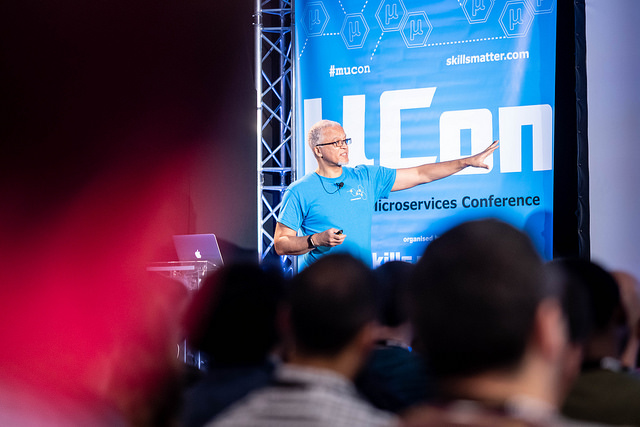
I’m teaching an updated version of my workshop - Designing microservices: responsibilities, APIs and collaborations - at the excellent Explore DDD conference that’s happening this September in Denver.
Here’s a Q&A that explores why this workshop is especially relevant in the age of GenAI, the common mistakes teams make when designing and developing microservices, and how the workshop equips attendees with a practical, repeatable approach to building microservice architectures that enable fast, sustainable software delivery.
What’s changed most about microservices design in recent years?
The recent surge in adoption of GenAI coding agents has strengthened the case for the microservice architecture. That’s because coding agents accelerate the flow of changes, which in turn demands an architecture that can support that increased flow rate. As a result, organizations will outgrow the monolithic architecture much sooner. What’s more, a service’s smaller codebase improves the effectiveness of coding agents.
And what’s stayed stubbornly the same?
Designing a microservice architecture is still high stakes and challenging. A bad architecture will slow down delivery and threaten the success of the business. Yet at the same time, defining an architecture requires deep thinking to navigate numerous tradeoffs.
Where does AI genuinely help in designing services, and where does it often confidently steer someone wrong?
GenAI is a helpful design assistant. It can extract domain models and APIs from requirements, suggest service decompositions, identify responsibilities, generate APIs, and rapidly explore alternatives. However, despite appearances to the contrary, GenAI is a next-token predictor that understands nothing and cannot reason. It can define a superficially plausible yet deeply flawed architecture - for example, one that looks reasonable at a glance but bakes in tight coupling or the wrong service boundaries. Human architects are therefore still essential: they define the architectural guardrails that guide GenAI, and they exercise the judgment needed to make the architectural decisions.
What mistake(s) do teams most often make when they carve a system into microservices?
I regularly encounter organizations that have built an excessively fine-grained service architecture, where each small team owns many services - e.g., one service per team member, or worse. Such architectures are difficult to understand and maintain, and there’s often tight design-time and runtime coupling. What’s more, instead of solving business problems, teams are forced to deal with distributed systems issues such as complex coordination logic.
What does a day in this workshop actually look like, hands-on?
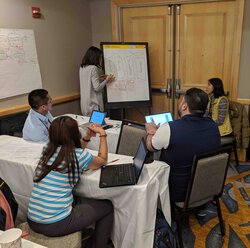
While there are lectures, the core of the workshop - and the most fun part - is the design exercises and the discussions. The day alternates between short lectures that introduce concepts and exercises that immediately put them into practice, with attendees working together in small groups to design a microservice architecture. After each design exercise, there are great discussions comparing the different groups’ designs, debating the tradeoffs, and discovering that there’s rarely one right answer.
What will attendees be able to bring back to their teams to help them succeed with microservices?
Attendees leave with several concrete takeaways:
- A deep understanding of key microservice architecture concepts, including when - and when not - to use microservices.
- A practical, repeatable approach for defining a microservice architecture with the appropriate level of granularity.
- Techniques for designing services that are loosely coupled at both design-time and runtime.
- How to apply the service collaboration patterns.
To learn more
To learn more about the workshop, and to register, visit the Explore DDD conference website. And, if you would like me to teach this workshop at your organization, please contact me.
Need help with modernizing your architecture?
I help organizations modernize their architecture to enable fast flow and GenAI-powered software delivery. If you’re planning or struggling with a modernization effort, I can help.
Learn more about my modernization and architecture advisory work →


 Premium content now available for paid subscribers at